All Projects
Web Development

CinCin YVR CoHost

Stack

Next.js, Tailwind CSS, Sanity CMS

CinCin YVR CoHost

Project Overview

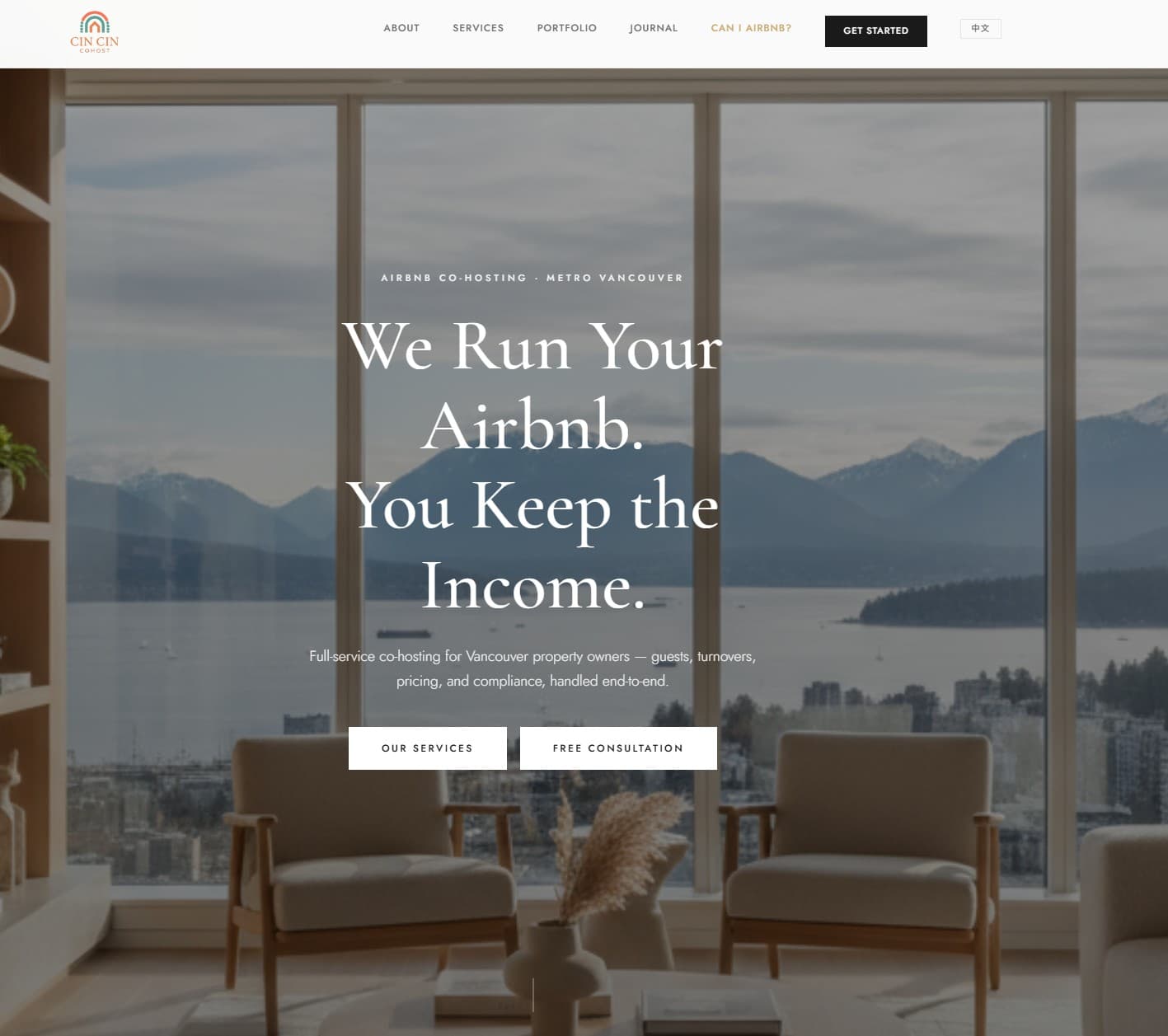
Premium restaurant co-hosting platform connecting Vancouver's finest dining experiences with global guests.

Key Results

< 1.2s

Page Load

95+

Lighthouse Score

40%

Conversion Lift

CinCin YVR CoHost screenshot 1
CinCin YVR CoHost screenshot 2

Case Study

The Challenge: From Zero to Competitive in a Crowded Market

When CinCin YVR CoHost approached us, they were a new entrant in Vancouver's short-term rental management space — a market already saturated with established property managers and co-hosting platforms. They had no digital presence, no organic search visibility, and no systematic way to onboard prospective hosts or communicate with their cleaning and maintenance teams.

The co-hosting industry in Vancouver operates under a complex web of municipal by-laws, zoning regulations, and licensing requirements that change frequently. Prospective hosts needed answers to critical questions: Is my property eligible for short-term rental? What permits do I need? What are the occupancy limits for my zone? Previously, these answers required hours of research or expensive consultations.

Beyond the regulatory complexity, the day-to-day operations of managing multiple Airbnb properties created massive communication overhead. Every booking notification from Airbnb triggered a cascade of manual tasks — notifying cleaners, updating schedules, confirming turnovers. The operator was spending 20+ hours per month simply coordinating messages between platforms, contractors, and property owners.

CinCin YVR CoHost needed more than a website. They needed a full digital operations platform that could attract new hosts, answer complex regulatory questions instantly, and automate the operational backbone of their business.

Building a Bilingual Platform That Ranks

We designed and developed a high-performance Next.js application deployed on Vercel, purpose-built for speed, SEO, and conversion. Every architectural decision was made with search visibility in mind — from server-side rendering and semantic HTML structure to meta tag automation and structured data markup.

Within the first two months of launch, the site achieved top-10 rankings for competitive local keywords in the Vancouver co-hosting space. This wasn't accidental. We implemented a programmatic SEO strategy targeting long-tail queries around short-term rental regulations, co-hosting services, and neighbourhood-specific landing pages.

Given Vancouver's diverse population, we built the platform with full bilingual support powered by AI translation. Rather than relying on basic machine translation that produces awkward, robotic text, we implemented a pipeline that preserves context, tone, and industry-specific terminology across English and Mandarin. Every page, every interactive element, and every piece of dynamic content renders natively in both languages — giving CinCin YVR CoHost a significant competitive advantage in reaching Vancouver's multilingual host community.

The bilingual system isn't a bolt-on feature. It's woven into the content management layer so that new content published in one language is automatically queued for AI-assisted translation, reviewed, and deployed — keeping both language versions of the site perfectly synchronized without manual effort.

The RAG-Powered Feasibility Study: Answering Regulatory Questions in Real Time

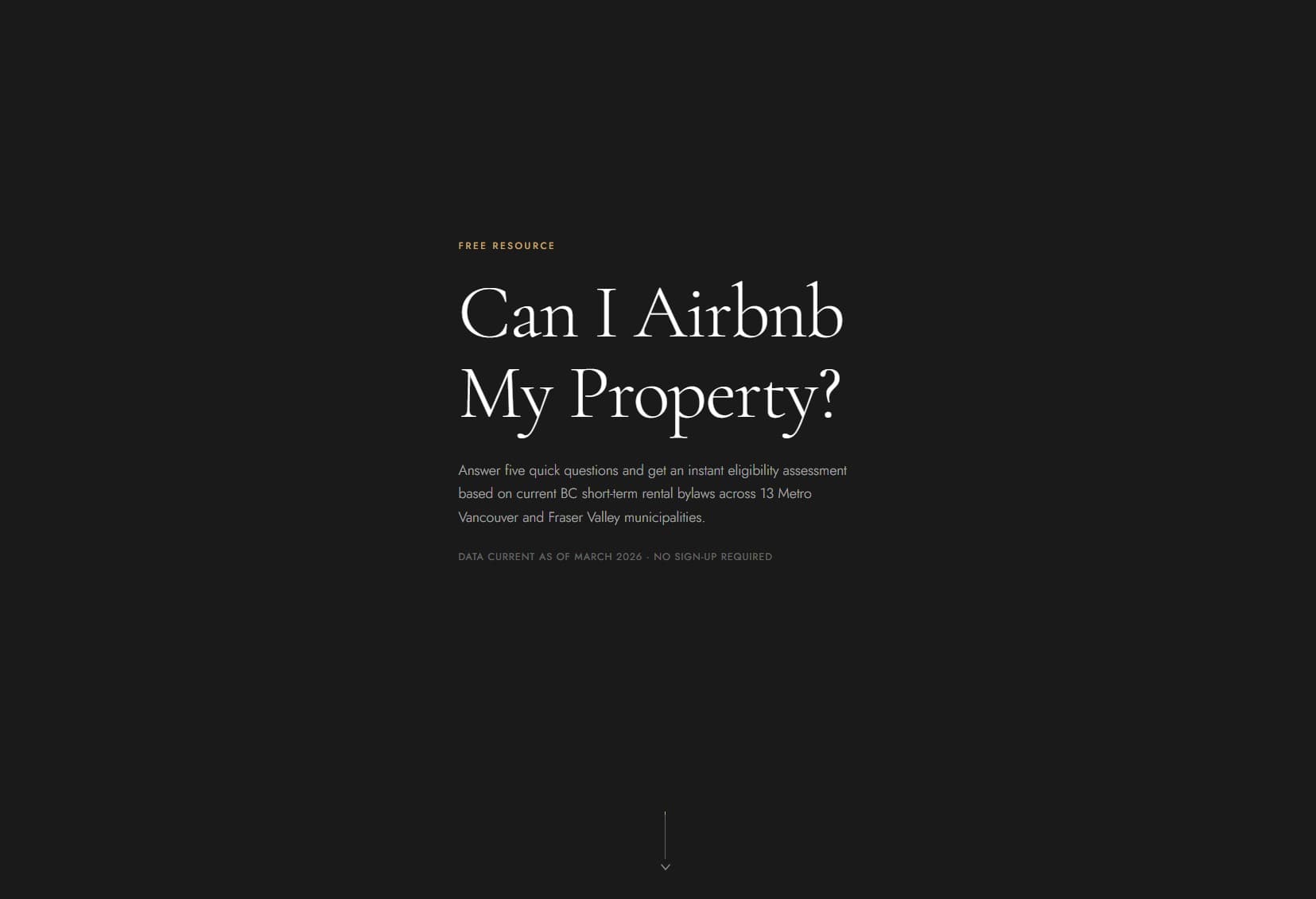
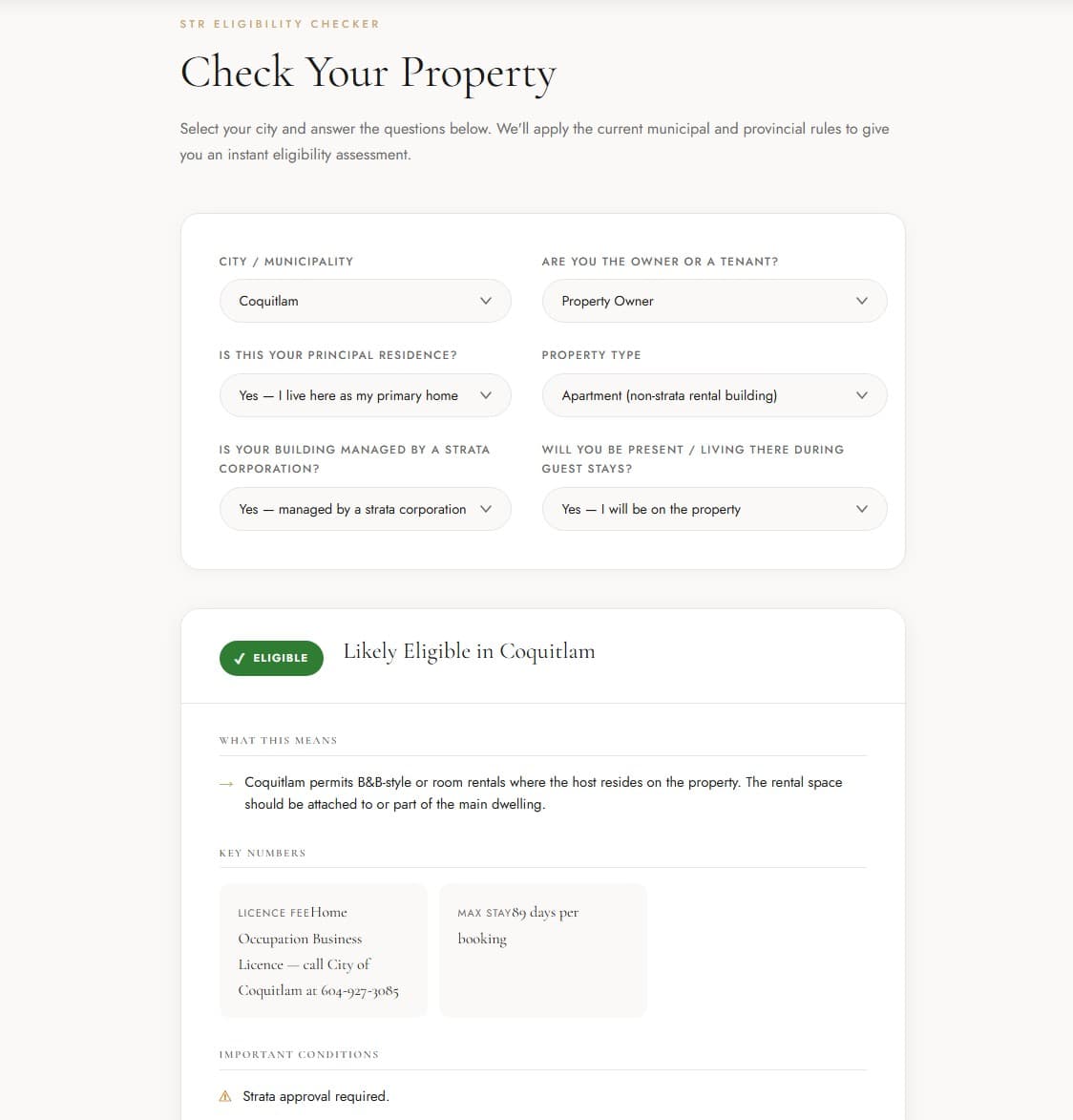
The centrepiece of the platform is an interactive feasibility study tool that lets prospective hosts determine whether their property qualifies for short-term rental — in real time, with no phone calls, no consultations, and no guesswork.

Under the hood, this tool is powered by a Retrieval-Augmented Generation (RAG) system. We ingested, parsed, and indexed the City of Vancouver's short-term rental by-laws, zoning regulations, and licensing requirements into a structured knowledge base. When a user enters their property details, the system queries this knowledge base and generates an accurate, contextual response specific to their property's zone, type, and licensing status.

This isn't a simple FAQ or decision tree. The RAG system handles nuanced queries that span multiple regulatory documents. It understands the difference between a laneway house in a RS-1 zone and a basement suite in a RT-2 zone, and it surfaces the specific by-law provisions that apply to each scenario. The responses include references to the source regulations so that users can verify the information independently.

The feasibility study transformed CinCin YVR CoHost's sales funnel. Instead of prospects bouncing off a generic services page, they now engage with an interactive tool that provides immediate, personalized value. The tool captures lead information naturally — users willingly provide their property details in exchange for a regulatory assessment — creating a qualified pipeline of hosts who have already confirmed their property's eligibility.

We designed the system with a regular update mechanism that refreshes the knowledge base as municipal regulations change. This ensures the tool always reflects current by-laws, maintaining the trust and accuracy that make it a genuine competitive moat for the business.

Automating Operations: The Real-Time Notification Engine

The most impactful piece of this engagement wasn't visible to website visitors at all. It was the operational automation layer that transformed how CinCin YVR CoHost manages their portfolio of properties.

We built a real-time notification system that connects Airbnb's booking platform to the operator's CRM through Airtable as the central data hub. The workflow is triggered the moment a new booking, cancellation, or modification is received from Airbnb. Here's how it works:

When a booking notification arrives, the system automatically identifies which property is involved, looks up the assigned cleaning team for that property, calculates the check-in and check-out times, and pushes a formatted notification to the correct cleaner with all the details they need — property address, guest count, special instructions, and timeline. Simultaneously, it updates the master schedule in Airtable and logs the event in the CRM for the property owner's records.

Cancellations trigger a reverse workflow: the cleaner is notified that the turnover is cancelled, the schedule is updated, and the property owner receives a status update. Modification events — date changes, guest count changes — automatically propagate to all affected parties.

Before this system, the operator was manually checking Airbnb notifications, cross-referencing a spreadsheet of properties and cleaners, copying details into messages, and sending them individually. For a portfolio of multiple properties with overlapping bookings, this consumed well over 20 hours per month of pure administrative work.

The automation eliminated nearly all of that communication overhead. The operator now focuses on growth, guest experience, and property relationships instead of playing message relay. The cleaners receive consistent, accurate instructions every time, reducing errors and missed turnovers. Property owners receive transparent, timely updates that build trust and retention.

The Technology Stack and Architecture Decisions

Every technology choice in this project was driven by a specific business requirement:

Next.js was selected for its hybrid rendering capabilities. Pages that needed SEO visibility — service pages, neighbourhood landing pages, the blog — are server-rendered for optimal crawlability. Interactive features like the feasibility study tool use client-side rendering for responsiveness. This hybrid approach gives us the best of both worlds: search engine performance and user experience.

Tailwind CSS provided the design system foundation, enabling rapid iteration on the visual design while maintaining consistency across all breakpoints. The site is fully responsive, performing flawlessly on mobile devices where the majority of prospective hosts first encounter the brand.

Sanity CMS powers the content layer, giving the CinCin YVR CoHost team full control over blog posts, service descriptions, and FAQ content without needing developer intervention. The headless CMS architecture means content updates deploy instantly through the existing CI/CD pipeline.

Vercel handles deployment with edge caching, automatic SSL, and preview deployments for every content change. The site consistently scores 95+ on Lighthouse performance audits, which directly contributes to its strong search rankings.

The Airtable-CRM integration uses webhook-based triggers with retry logic and error handling to ensure no notification is ever lost. We built monitoring dashboards that alert the operator if any notification fails to deliver, providing a safety net for the automated workflow.

Results and Ongoing Impact

The numbers tell the story. Within two months of launch, CinCin YVR CoHost was ranking in the top 10 for their target keywords — a timeline that typically takes 6-12 months for a new domain in a competitive local market. The programmatic SEO strategy and technical foundation made this accelerated timeline possible.

The interactive feasibility study generates qualified leads at a rate significantly higher than the industry average for service-based businesses. Prospects who complete the assessment convert at a 40% higher rate than those who simply visit the services page, because they've already received value and confirmed their property's eligibility before ever speaking with the team.

Operationally, the automation system saves over 20 hours per month of manual communication work. That time has been redirected to business development and guest experience improvements, directly contributing to portfolio growth.

The client reported that the platform has fundamentally changed how they operate their business. The combination of a high-performing digital presence, an AI-powered lead qualification tool, and automated operations created a competitive advantage that their rivals have struggled to replicate.

This project exemplifies what's possible when AI, automation, and strategic web development are applied together to solve real business problems — not as buzzwords, but as practical tools that save time, generate revenue, and scale without scaling the team.

Challenge

The restaurant needed a digital presence that matched its premium in-person experience while driving reservations.

Approach

Built a performance-first Next.js site with rich imagery, seamless booking integration, and SEO-optimized content.

Results

Launched a high-converting platform that elevated the brand online and increased direct bookings.

Next Project

Zealous Digital