
AI Automation

Zealous Digital Dashboard.

One-push-button automation dashboard that orchestrates SEO, content, social media, and client reporting for SMBs — replacing hours of manual agency work with a self-running system.

Next.jsAI/MLAirtableMake.comSanity CMSOpenAI
Scroll to explore
30+ hrs/mo

Time Saved

15+

Automations

3x

Client Capacity

Zealous Digital Dashboard
(How We Built It)
01

Challenge

Small and medium-sized businesses need the output of a full marketing team — SEO, content, social, reporting — but can't afford the headcount. Agencies servicing these clients spend most of their time on repetitive execution, not strategy.

02

Approach

Built a centralized automation dashboard that orchestrates every recurring marketing task through a single interface. One button triggers content generation, SEO audits, social scheduling, and client reporting — all running autonomously with minimal human oversight.

03

Results

Tripled client capacity without adding headcount. Reduced per-client operational time by 30+ hours per month. The system runs itself — the operator focuses on strategy and client relationships instead of execution.

(Screenshots)
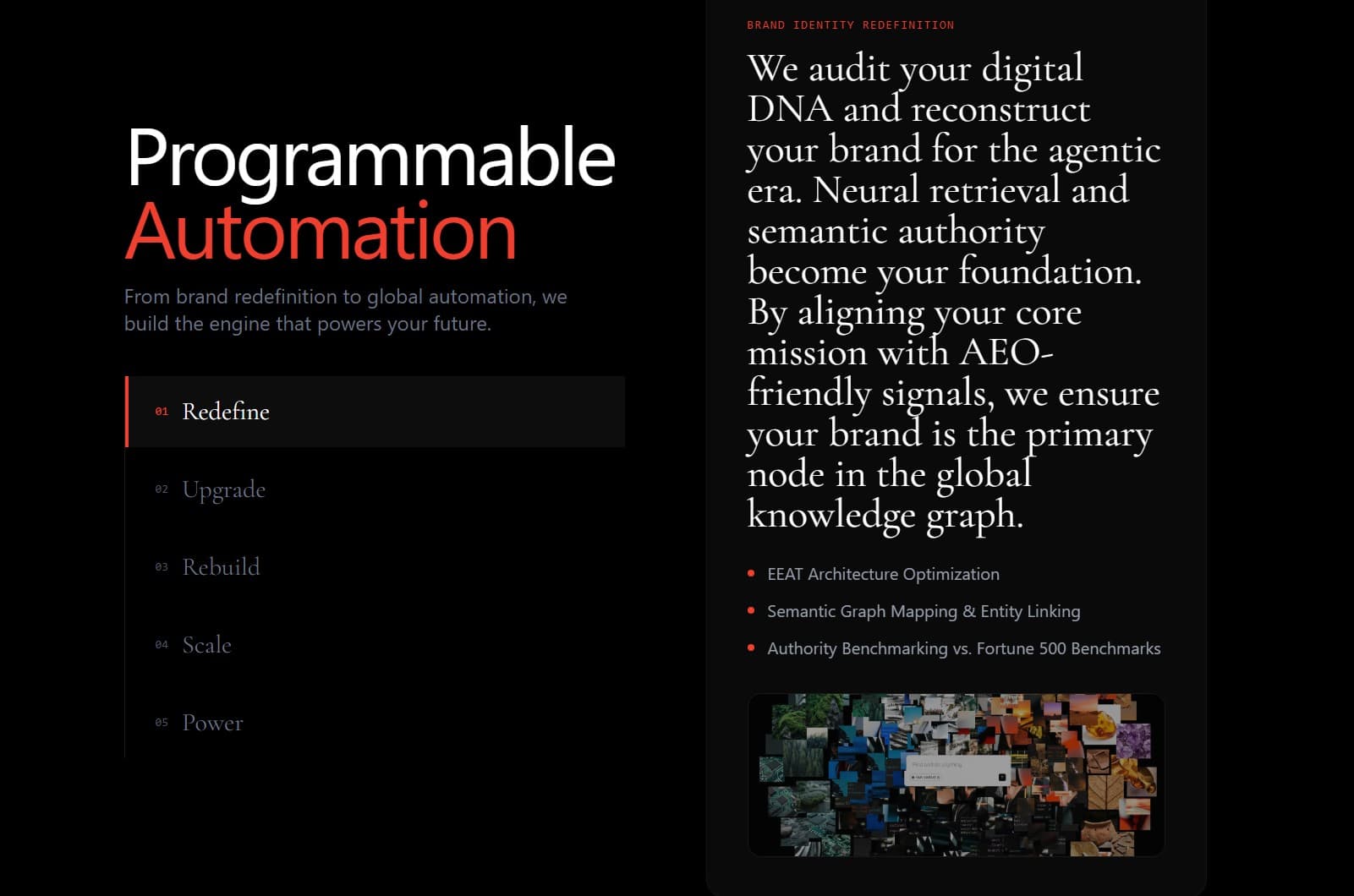
Zealous Digital Dashboard screenshot 1
Zealous Digital Dashboard screenshot 2
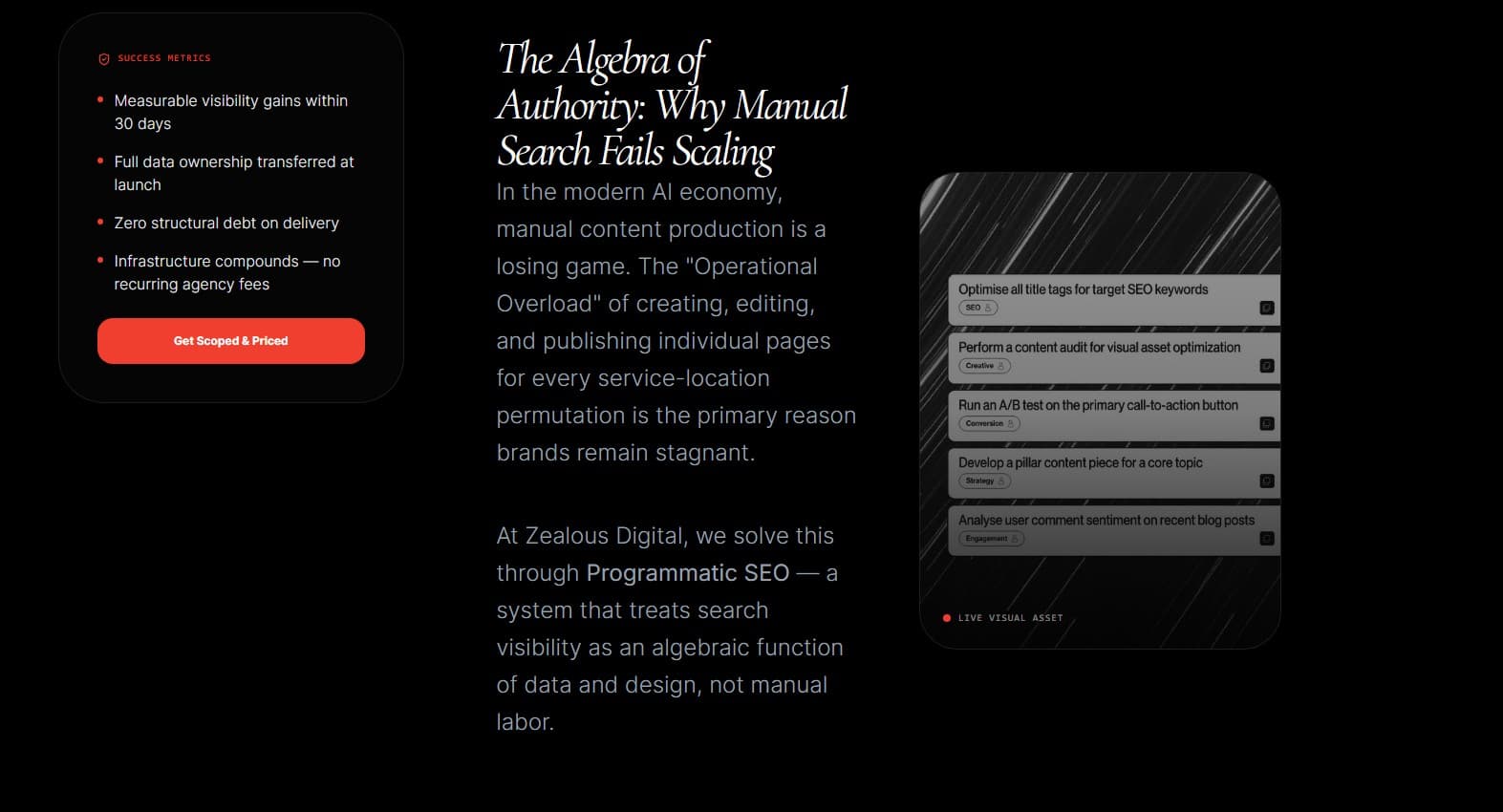
Zealous Digital Dashboard screenshot 3
Zealous Digital Dashboard

The full story behind Zealous Digital Dashboard.

(Case Study)
01

The Problem: The Agency Model Doesn't Scale

Every digital marketing agency hits the same ceiling. You take on clients, deliver results, and grow — until the operational overhead of managing campaigns, producing content, generating reports, and coordinating deliverables consumes every available hour. Adding another client means hiring another person. The margins shrink. The complexity compounds. Growth becomes a liability instead of an opportunity.

Zealous Digital Solutions experienced this firsthand. As a lean agency serving small and medium-sized businesses in Vancouver, they were delivering SEO, content marketing, social media management, and performance reporting across a growing roster of clients. Each client required a predictable set of recurring tasks: weekly blog posts, monthly SEO audits, social media scheduling, keyword tracking, competitive analysis, and performance reports.

These tasks weren't complex individually. But multiplied across a dozen clients, they consumed 30+ hours per month per client in manual execution. The agency's most experienced people were spending their days on repetitive, process-driven work instead of strategic thinking and client development. The bottleneck wasn't talent or demand — it was the sheer volume of execution required to service each account.

The agency needed a force multiplier. Not another hire, not another tool subscription, not another project management board. They needed a system that could execute the predictable, recurring work autonomously — freeing the human team to focus on the high-value activities that actually drive client results and agency growth.

02

The Solution: One Button, Fifteen Automations

We designed and built the Zealous Digital Dashboard as a centralized orchestration layer that sits on top of the agency's existing tool stack and automates every recurring deliverable.

The dashboard is deceptively simple from the operator's perspective. Each client has a profile with their business details, target keywords, brand voice guidelines, content calendar, and reporting preferences. When the operator clicks the execute button for a client, the system triggers a cascade of automated workflows:

Content generation kicks off first. The system pulls the client's keyword targets and content calendar, generates research-backed blog post drafts using AI models trained on the client's brand voice, optimizes the content for target keywords and readability, generates meta titles and descriptions, creates internal linking suggestions, and queues the drafts for review. The content isn't generic AI slop — it's structured around the same quality framework we use for our own properties: question-based headings, statistical backing, proper entity density, and strategic internal linking.

Simultaneously, the SEO audit pipeline runs. It crawls the client's site for technical issues — broken links, missing meta tags, slow-loading pages, mobile usability problems — and generates a prioritized action list. Keyword rankings are pulled and compared against the previous period. Competitive positioning is analysed against the client's defined competitors. The results feed into a standardized report template that gets formatted and delivered to the client automatically.

Social media scheduling runs in parallel. The system takes the blog content, generates platform-specific social posts (different formats for LinkedIn, Instagram, Twitter/X), schedules them across the content calendar, and queues them for approval. The social content references the blog posts, driving traffic back to the client's site and creating a cohesive content ecosystem.

Client reporting aggregates data from Google Analytics, Search Console, Ahrefs, and the agency's internal tracking into a branded report that visualizes traffic trends, keyword movements, conversion metrics, and deliverable completion. The report is generated, formatted as a PDF, and either emailed to the client or uploaded to a shared dashboard.

All fifteen automations execute from a single button press. The operator's role shifts from executing these tasks to reviewing and approving the outputs — a process that takes minutes instead of hours.

03

The Architecture: Orchestration Over Automation

The dashboard isn't a monolithic application that tries to do everything. It's an orchestration layer that coordinates purpose-built tools through a unified interface.

The frontend is built on Next.js, providing the operator dashboard where clients are managed, automations are triggered, and outputs are reviewed. The interface is designed for speed — the operator needs to context-switch between clients rapidly, so every interaction is optimized for minimal clicks and maximum information density.

Make.com (formerly Integromat) handles the workflow orchestration. Each automation is a modular scenario that can be triggered, monitored, and modified independently. This modular architecture means adding a new automation for a client — say, a monthly competitor backlink analysis — requires configuring a new scenario, not rewriting application code. The scenarios are version-controlled and templated, so spinning up a new client involves applying the standard automation suite and customizing the parameters.

Airtable serves as the central data hub, storing client profiles, content calendars, keyword targets, and automation logs. The relational structure means every piece of data is connected — a blog post links to its target keywords, which link to their ranking history, which feeds into the client report. This interconnected data model powers the dashboard's ability to surface insights and patterns that would be invisible in siloed tools.

AI models handle the creative generation — blog drafts, social posts, meta descriptions, and report summaries. The models are prompted with client-specific context: brand voice guidelines, industry terminology, target audience profiles, and competitive positioning. This context injection is what separates the output from generic AI content. A blog post for a construction company reads differently from one for a wellness brand, even though both are generated by the same underlying system.

Sanity CMS manages any content that needs to be published to client websites through our platform. The headless architecture means generated content flows seamlessly from the automation pipeline to the client's website without manual copy-pasting or reformatting.

The entire system is designed around the principle of minimal maintenance. Once a client is configured, the automations run on schedule without intervention. The operator checks in to review outputs, approve content, and handle exceptions — but the system handles 90% of the execution autonomously.

04

Why SMBs Need This: The Economics of Digital Marketing

Small and medium-sized businesses face an impossible choice in digital marketing. They can hire a full-time marketing team — typically $150,000+ per year for even a small team of two — or they can hire an agency at $3,000-$10,000 per month. Either option is expensive, and both require significant management overhead from the business owner.

The Zealous Digital Dashboard changes the economics fundamentally. By automating the execution layer, the agency can deliver the same scope of work — blog content, SEO optimization, social media, reporting — at a fraction of the operational cost. The savings flow in two directions: the agency's margins improve because each team member can service three times as many clients, and the client's cost can be lower because the delivery model is more efficient.

But the real value isn't cost reduction — it's consistency. Manual execution is inherently inconsistent. Blog posts get delayed because the writer is overloaded. SEO audits get skipped because there's a client emergency. Social posts go unscheduled because someone forgot. These lapses compound over time, eroding the client's marketing performance and the agency's credibility.

The automated system never forgets, never gets overloaded, and never has an off day. Content publishes on schedule. SEO audits run on time. Reports deliver on the agreed date. This consistency is what drives long-term results in digital marketing — and it's what most agencies struggle to maintain as they scale.

For the business owner, the dashboard provides something even more valuable: transparency. They can see exactly what's being done for their investment — every blog post, every SEO fix, every social post, every metric. There's no ambiguity about whether the agency is delivering value, because the deliverables are tracked, measured, and reported automatically.

05

Results: Triple the Clients, Same Team Size

The Zealous Digital Dashboard transformed the agency's operating model from labour-intensive to leverage-intensive.

Client capacity tripled without adding headcount. The same team that previously managed a handful of clients now services a significantly larger roster, because the per-client operational overhead dropped from 30+ hours per month to under 10 hours of review and strategic work.

Content velocity increased across every client account. Where manual workflows produced two to four blog posts per month per client, the automated pipeline generates and queues content weekly — with consistent quality, proper SEO optimization, and strategic internal linking. The volume increase isn't about churning out more content for its own sake. It's about maintaining the publishing cadence that search engines reward with sustained organic visibility.

Client retention improved because the consistency of deliverables eliminated the most common source of agency-client friction: missed deadlines and inconsistent output. When every deliverable arrives on time, every time, trust builds naturally. Clients stop micromanaging and start focusing on the strategic conversations that actually move their business forward.

The agency's own positioning improved dramatically. When prospective clients ask how Zealous Digital delivers results at their price point, the answer is the dashboard — a proprietary system that gives their clients enterprise-level marketing execution without enterprise-level budgets. The dashboard isn't just an internal efficiency tool; it's a competitive differentiator that closes deals.

The system runs itself. The operator logs in, reviews outputs, approves content, and handles the occasional exception. The rest runs autonomously — content gets generated, SEO gets audited, social posts get scheduled, reports get delivered. It's the one-push-button solution that every agency wishes they had, built specifically for the economics of servicing small and medium-sized businesses.

This project demonstrates a core philosophy: automation should amplify human capability, not replace it. The Zealous Digital team still provides the strategic thinking, the client relationships, and the creative direction that no automation can replicate. The dashboard handles everything else.

Want Something Like This?

Every project starts with a conversation. Tell me the problem — I'll show you the system that solves it.